
Decision intelligence · practical reference
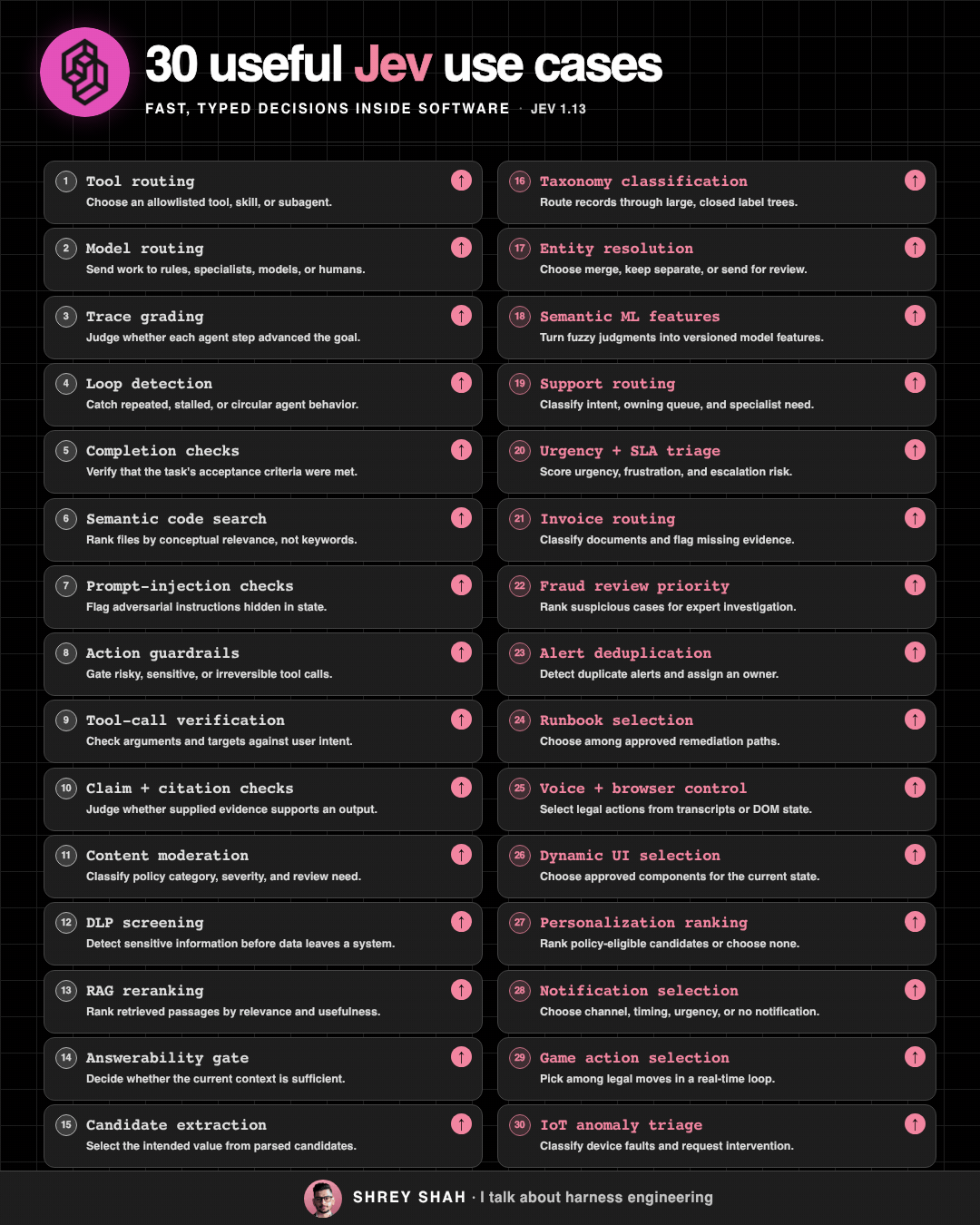
30 useful Jev use cases
A field guide to the bounded decisions Jev can make inside software, with implementation patterns, risk posture, and direct source links.
Working model: reasoning models plan and generate; Jev classifies, ranks, verifies, and routes; code owns policy and side effects; humans resolve uncertain or high-impact cases.
3Choice, Noul, and Score primitives
255Maximum documented Choice options
70–500 msProvider-reported response range
$0.042/MListed input-token price; output free
Where Jev fits
Jev accepts text or structured application state and returns bounded, typed judgments with probabilities. It does not write prose, code, plans, or explanations.
The strongest applications have a declared answer space, high decision volume, useful uncertainty, and a safe fallback. The cards below separate reversible automation from decisions that should only gate or escalate.
30 / 30
No use cases match this filter.
How to pilot one safely
- Choose one narrow decision and collect representative labeled cases.
- Include unknown, none, or escalation when the declared options may not fit.
- Pin the Jev model version and log the full probability distribution.
- Compare against rules, classical classifiers, and a minimal structured-output LLM.
- Measure precision, recall, calibration, coverage, latency, cost, and downstream harm.
- Keep authentication, authorization, arithmetic, policy, and side effects in deterministic code.
Typed does not mean correct. Jev cannot return an undeclared option, but it can select the wrong valid option. “Zero hallucinations” is a schema-validity claim, not proof of semantic accuracy.